Categories
What is EDGE certification?
EDGE certification makes sustainable construction accessible worldwide: learn how to achieve 20% reductions in energy, water, and embodied material consumption.
By Edward Borgstein
Oct 07, 2017
Energy Efficiency
What is EDGE certification?
Specific to emerging markets and already available in 130 countries, the EDGE system (Excellence in Design for Greater Efficiencies) is a building certification program developed by the IFC, a member of the World Bank Group, which aims to optimize resource efficiency in projects and demystify sustainable construction.
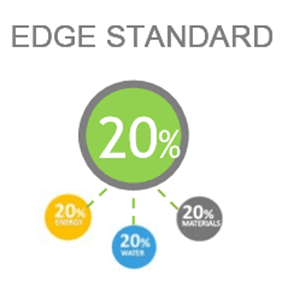
EDGE consists of software running on a web platform, a standard, and a sustainability certification system. The software can be accessed free of charge and allows for the evaluation of a construction project according to an appropriate baseline calibrated to the country in question. To meet the minimum certification requirement established by the EDGE standard, the project must demonstrate a 20% reduction in energy consumption, water, and embodied energy in materials compared to the baseline.
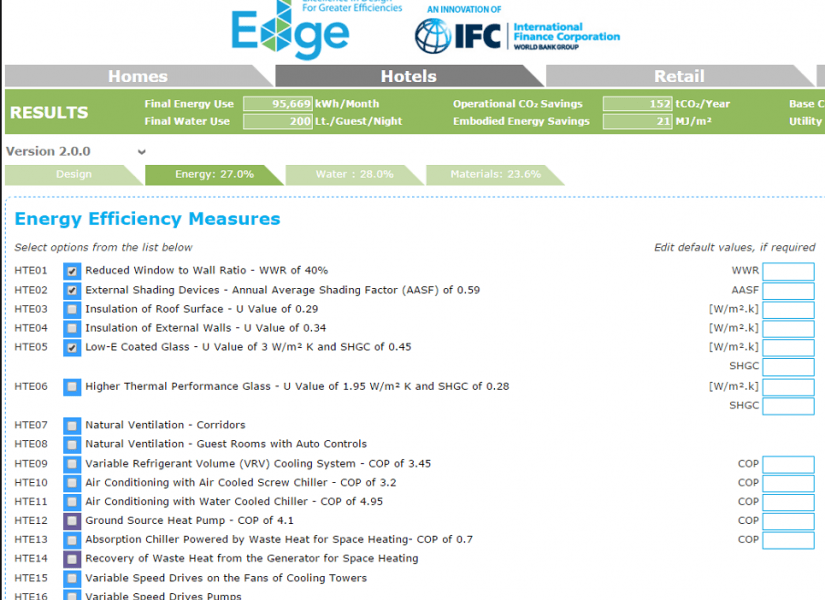
In addition to allowing project registration and submission to the certification body, the software enables the evaluation of different sustainable construction technologies, considering incremental investment costs and operational savings, thus identifying the technologies with the best return for that specific project.
"Evaluating the feasibility of construction technologies or strategies has never been easier. Instead of spending days doing energy simulations, it is possible to have a view of the project's performance in literally a few minutes." – Says Maxine Jordan, one of the first three EDGE Auditors in Brazil.
The program is currently available for new and existing buildings for commercial use (offices and retail stores), educational, residential, healthcare, and hospitality (hotels).
What is the step-by-step process for EDGE certification?
1. Baseline definition
Through the online platform, the user fills in a series of basic information about the project, including: typology; geographic location; area; number of floors; predicted number of occupants, solar orientation, existence of artificial air conditioning, among others. Based on these input data, a reference building is created to serve as a baseline for comparison with the evaluated building. The annual energy consumption of the reference building will be calculated using a quasi-steady-state¹ modeling method based on the ISO 13790 standard and the European CEN standard. Its consumption is defined by user input data, equipment efficiencies, and building envelope, based on Brazilian standards and construction techniques, so that it represents a typical building of the country.
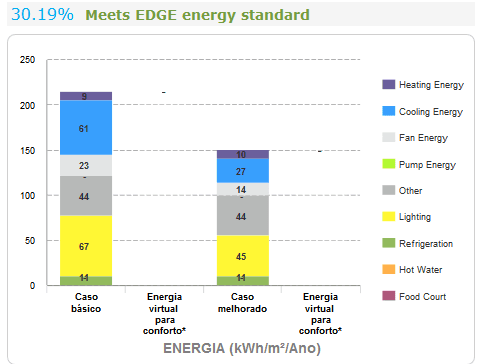
¹ Quasi-steady-state modeling sits between steady-state modeling, which considers only one moment of operation (on the worst day), and dynamic simulation, which considers performance throughout the year.
2. Selection of energy, water, and materials efficiency measures
Some input fields are mandatory, such as the window-to-wall ratio on the facade, thermal transmittance of walls and roof, and the efficiency (COP) of the air conditioning system. Next, the user selects measures to be included in the project from a “menu” of measures.
Some options on this menu include: LED lighting, high reflectance of walls or roofing, variable frequency drives in ventilation systems, inclusion of renewable energy generation, installation of aerators in faucets, etc. For each selected measure, the incremental cost, operational savings, and reduction in consumption of the evaluated building compared to the base model are shown. Comprehensive technical guidance on each measure is also provided.
Regarding materials, the user defines those used in different constructive elements such as slabs, roofing, walls, etc. The reduction of embodied energy in the material is then estimated relative to the baseline, already calibrated with local construction techniques.
3. Registration and certification
Once the evaluated building reaches a reduction percentage of at least 20% for each of the resources (energy, water, and materials) compared to the reference building's baseline, it can seek certification. The process begins with the registration of the previously saved and evaluated project in the EDGE program. An EDGE auditor must then be hired to conduct a project audit to verify all declared data. Then, after conformity is attested, a preliminary certification is issued (in the case of buildings in the design phase). Final EDGE certification is issued after verification of the conformity of the built building.
The entire process, from registration, evaluation, and compilation of building evidence, can be carried out by the design team itself. It is also possible to hire a consultancy with a specialized professional (EDGE Expert) to support all procedures related to obtaining certification.
Why another one? What is the differential of EDGE certification?
EDGE was born from the need for a legitimate, validated, simple, cheap, and accessible way to recognize sustainable construction and guide decision-making. This need is evidenced by the high cost and complexity of traditional certification programs.
One of its main differentials is the availability of a free online platform, easy to access and use, which can effectively provide guiding information for the design of more efficient and sustainable buildings. In this way, it is possible to easily identify measures with the most significant environmental and economic impacts, ensuring that investment capital is better utilized and that the sustainable construction market is accessible to everyone. As a powerful project decision-making tool, it assists the process by identifying which measures have the greatest impact and best financial return. In this way, it is guaranteed that investment capital is better utilized, and that the sustainable construction market is accessible to everyone.
How much does it cost?*
Project registration for certification costs $300 USD.
The certification has different costs depending on the chosen Certification body. Currently in Brazil, there is the option to certify through GBCI or SGS/Thinkstep.
The cost of audits also depends on the chosen Certification body. Through GBCI, audit prices are negotiated directly with the auditor
There is also the option of hiring an EDGE Expert to assist with the process and documentation compilation. The EDGE Expert can be hired directly from the list of professionals accredited by the IFC
*Values and procedures refer to the years 2017 and 2018. Currently (2019), to check certification costs, it is necessary to request a quote through a form available on the EDGE system website
EDGE in Brazil
EDGE has great growth potential in Brazil regarding the stimulation of the sustainable construction market. Equivalence studies of energy performance evaluation by EDGE and the PBE Edifica method showed that a commercial building meeting the EDGE standard would have energy consumption 10% lower (i.e., better) than a building with a Level A label from PBE Edifica. Thus, projects with EDGE certification also tend to present excellent performance through the Brazilian Labeling Program for Buildings (PBE Edifica).
With signs of a recovery in the Brazilian construction market, the opportunity to implement this powerful tool expands. With the training of new EDGE Experts and Auditors through GBCI (https://edge.gbci.org/auditors), a new page of civil construction, cleaner and high-efficiency, becomes more evident and accessible.