Categorías
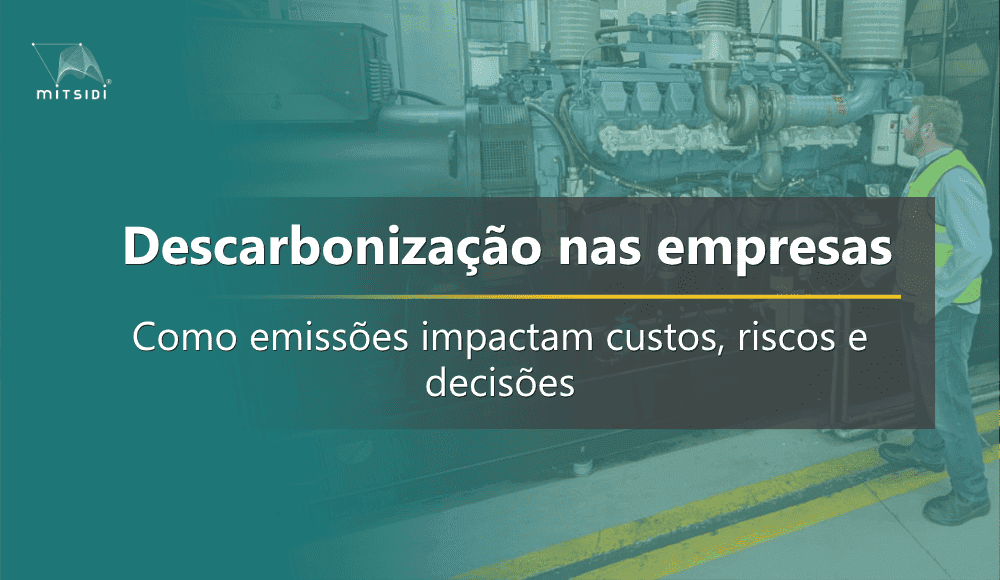
Decarbonization in companies: how emissions impact costs, risks, and decisions
Understand how emissions management and decarbonization impact costs, risks, and strategic decisions in companies, based on data and operations.
Por Fabio Frasson
may 11, 2026
Eficiencia energética
Sostenibilidad
Greenhouse gas emissions are directly related to the way a company operates and, therefore, impact costs, exposure to regulatory risks, access to capital, and competitiveness in the medium and long term. In this context, decarbonization becomes part of business management, no longer treated merely as a reputational or institutional agenda. Companies that associate emissions exclusively with corporate communication tend to lose the practical dimension of the topic. In operations, carbon behaves like any other strategic indicator, influencing decisions related to efficiency, operational performance, predictability, and risk exposure.
Where emissions come from and what they reveal about the operation
Every emission originates from concrete processes. Energy consumption, fuel use, the way production is structured, logistics, and the supply chain determine the volume of emissions generated. When this set is analyzed consistently, what appears is not just a number, but a faithful portrait of the company's functioning.
This portrait often exposes differences between expected performance and what actually happens in the operation. Equipment operating outside ideal conditions, processes that are more intensive than necessary, and dependence on high-emission energy sources are identified more clearly. At the same time, exposure to cost variations and possible regulatory changes becomes more evident.
Emissions as a cost and risk factor for companies
Even where direct carbon pricing is not yet established, the economic effects of emissions are already part of the business routine. Higher energy costs, reporting requirements, stricter financing criteria, and pressure from customers and investors are concrete manifestations of this movement. Emission-intensive companies tend to operate with less predictability and greater vulnerability to external changes.
In parallel, large organizations also face challenges related to emissions from their supply chains, increasing the need for developing and monitoring suppliers under climate and compliance criteria.
Why treat carbon as an economic variable in decision-making
Considering carbon as an economic variable allows for the anticipation of these impacts. Instead of reacting to already established pressures, the company begins to structure decisions based on analysis and planning. This reduces the need for abrupt adjustments and improves the quality of choices over time.
The role of data in emissions management and decarbonization
In this process, reliable data makes a difference. Without a consistent base, decarbonization tends to rely on generic estimates and initiatives disconnected from operational reality. With structured data, the topic is treated as an integrated part of management.
Emissions inventories aligned with recognized methodologies allow for organizing information, identifying patterns, and building a more precise reading of the operation. From this base, it becomes possible to compare scenarios, evaluate the technical and economic viability of reduction actions, and prioritize initiatives with the greatest impact. The relationship between energy efficiency and emissions also becomes clearer, allowing for more consistent decisions.
How to structure decarbonization based on reliable data
Continuous performance monitoring prevents actions from losing consistency over time or failing to generate the expected results. More than measuring, it is about understanding what is happening and progressively adjusting the operation.
Business risk reduction through emissions management
One of the most relevant effects of this process is risk reduction. By understanding its emissions, a company sees its exposure to regulatory, technological, and market changes more clearly. This allows for planning gradual transitions, protecting assets, and reducing vulnerability to scenarios of accelerated transformation.
At the same time, more structured companies already incorporate climate adaptation issues into their risk planning, considering physical impacts capable of affecting operations, supply chains, infrastructure, and resource availability.
How to integrate decarbonization into company strategy and operation
When this reading is incorporated into management, decarbonization ceases to act in isolation and begins to influence structural decisions. Investment planning, asset management, operational efficiency, and governance begin to consider the topic in an integrated way. This strengthens the coherence between discourse, operation, and results—a factor increasingly observed by investors, partners, and customers.
Data-driven decarbonization as a basis for safer decisions
In this context, decarbonizing is less about isolated goals and more about the quality of decisions. It is about understanding how emissions connect with costs, risks, and operational performance, and incorporating this understanding into management.
Companies that treat carbon as strategic data can operate with more clarity, greater predictability, and better anticipation capacity.
In an environment of progressive changes, this capacity directly influences how the business sustains itself over time. More than reducing vulnerabilities, incorporating decarbonization into strategic decisions can become an important competitive advantage, strengthening efficiency, adaptation capacity, and positioning in a transforming market.
Technical Authorship
This content was developed by the Mitsidi content team based on the company’s experience in sustainability, energy efficiency, and decarbonization projects. The materials published in this section are prepared by the editorial team and reviewed by Mitsidi’s technical specialists.
About Mitsidi
Mitsidi is a specialist in sustainability, energy efficiency, and decarbonization, providing consultancy, research, training, and solution development for companies, buildings, and industries.
Learn more: Mitsidi
Contact Us: [email protected]
Related Articles:
- Energy Efficiency in Business Practice: How to Structure Reliable Technical Decisions
- Energy Efficiency And Consumption Management: How To Transform Data Into Decisions In Companies